Repair or replace: the load path test
One question decides it: is the load path intact?
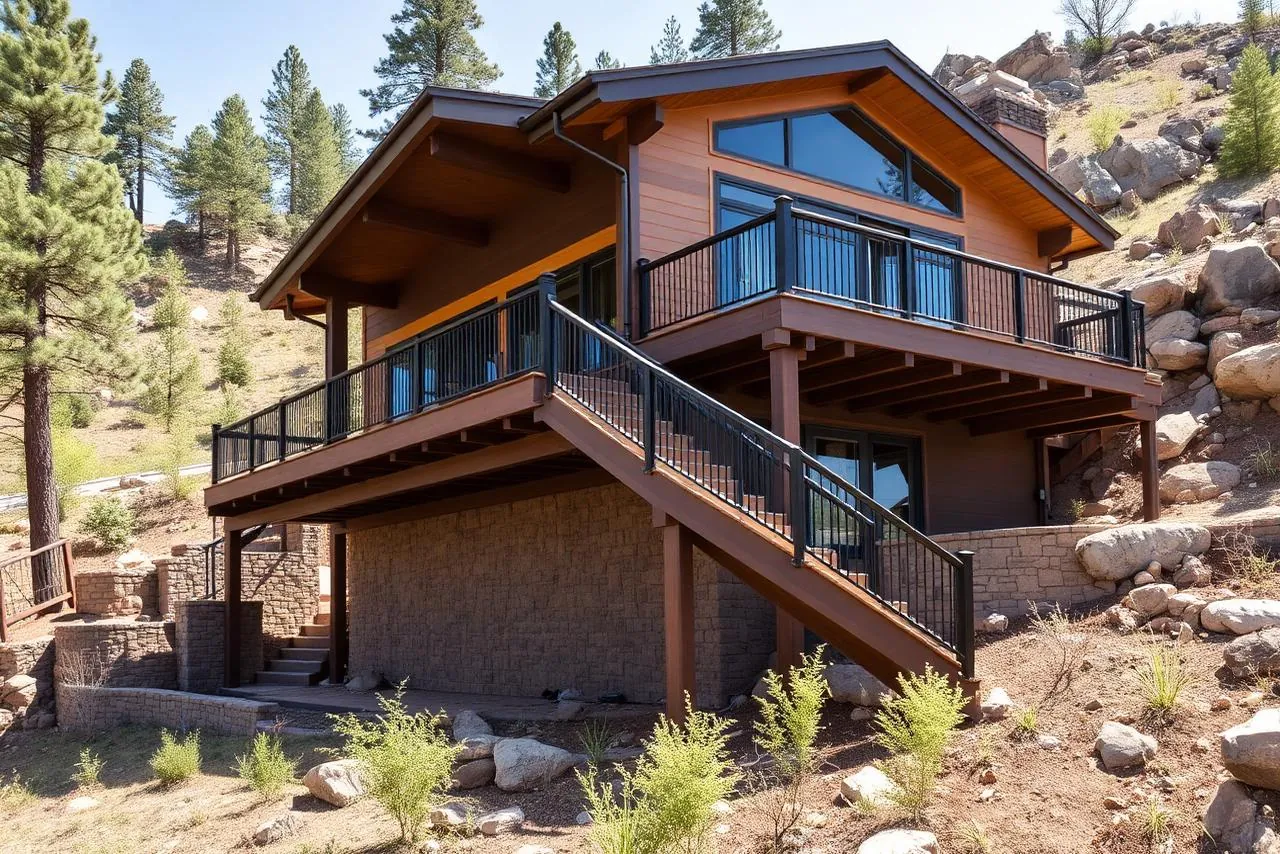
The load path is the chain carrying weight from the boards you stand on into the ground: decking to joists, joists to beam and ledger, ledger to house, beam to posts, posts to footings. Everything else on a deck is finish.
Repair territory
Split boards, backed-out fasteners, a soft stair tread, a wobbly run of railing, failed stain. The frame is sound and the problems sit on top of it.
Replacement territory
Rot or movement at the ledger, post bases holding water, shifted footings, cracked stringers, guard posts that flex under hand pressure. The chain itself is compromised.
The awkward middle case is the deck with a good frame and a bad detail — sound wood, correct spans, a ledger fastened in a way that would not be approved today. Not failing, and not something to put a new surface on top of either.
A full replacement runs the same ranges as new work — pressure-treated pine $35–60 per square foot installed, cedar $50–75, composite and PVC $45–95, as of August 2026. Estimates, not quotes; the cost page shows the arithmetic. The local replacement cluster is 190–300 square feet, the production-home back deck.
What fails first here, and why
Two local conditions do most of the damage.
Freeze-thaw. Colorado Springs runs roughly 138 freeze-thaw days a year — days where the temperature crosses freezing rather than staying below it. Water gets into a fastener hole or an end grain cut, freezes, expands, and enlarges the space it is in. Then it does it again, 138 times a year, exactly where the deck is drilled, cut or joined.
Derived from NOAA 1991–2020 Normals (159.7 days min ≤32°F − 21.3 days max ≤32°F). Verified 2026-08-04.
UV. At 6,035 feet roughly a fifth of the atmosphere is already below you, so direct sun is stronger than at sea level. It breaks down finish, grays wood and fades pigment. The west elevation takes the worst of it — and the Pikes Peak view from Colorado Springs is due west, so the deck built for the view is the deck pointed into the hardest light.
Elevation 6,035 ft — City of Colorado Springs. Verified 2026-08-04.
The five places to look
- Ledger connection and flashing. The most consequential detail on an attached deck. Covered below.
- Post bases. A post sitting flat on concrete with no standoff wicks water into its end grain and rots from the bottom up.
- Fasteners. Nails back out under 138 cycles of expansion and contraction a year.
- Stair stringers. Cut stringers lose most of their section at the notches and sit low to wet ground.
- Guard posts. A guard post fixed with two lag screws will pass a shove and fail a code load.
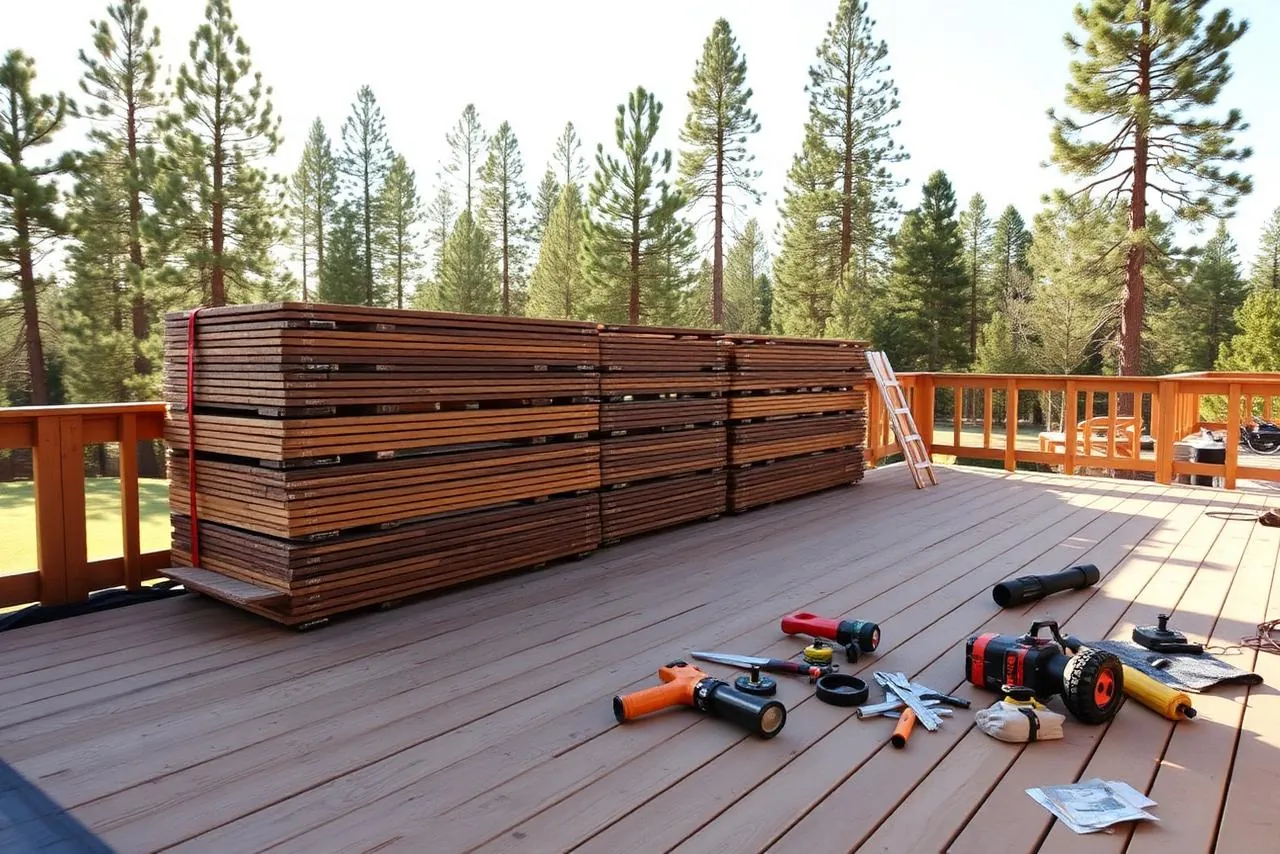
The ledger problem
The ledger is the board bolted to the house that carries one entire edge of the deck. A great many Colorado Springs decks from the 1990s and 2000s — the redwood and cedar decks now being replaced — have a ledger detail that would not pass review today.
In practice: nails instead of through-bolts or structural screws, no flashing over the top of the ledger, or a ledger fastened over siding rather than to the structure behind it. Any one of those puts water into the band joist of the house, which is a house problem rather than a deck problem.
The ledger is buried under the decking and behind the rim, invisible until the boards come off. A resurface is the moment it gets exposed, and the moment a straightforward job can turn into a structural one. Which is why the frame gets inspected before a resurface is priced, not after.
A ledger attached to a cantilever, to brick veneer, or to a manufactured home also pulls the deck out of the prescriptive tables and requires a Colorado licensed design professional — see permits and plan review.
When a repair triggers a permit
The line is drawn at the load path, not at the size of the job.
| Work | Treated as |
|---|---|
| Replacing boards, like for like | Maintenance |
| Refinishing, staining, cleaning | Maintenance |
| Altering or replacing framing | Structural |
| Altering or re-fastening the ledger | Structural |
| Replacing posts or footings | Structural |
| Adding stairs, or changing their geometry | Structural |
Resurfacing sounds like the first category and frequently ends up in the second. Pikes Peak Regional Building Department is the authority for all of it — fees, submittals and the three inspections are on the permits page.
Guards: the 30-inch trigger
A deck more than 30 inches above grade requires a guard. That threshold is why an old deck so often fails current rules the moment anyone measures it.
| Guard height | 36 in minimum |
|---|---|
| Guard trigger | Deck more than 30 in above grade |
| Infill opening | Must block a 4-inch sphere, including under the bottom rail |
| Cable railing | 3⅛ in on center — about 11 cables under a 36-inch rail |
| Metal post spacing | 48 in on center |
| Stairs | 7¾ in max rise, 10 in min tread, 36 in min width |
| Variation in a flight | ⅜ in maximum between any two risers |
| Handrail | 34–38 in above the nosing |
| Guard load | 200 lb at any point along the top |
| Deck design load | 50 psf total, per the regional code |
Three of those catch old decks repeatedly. Thirty-six inches of guard height, where plenty of older guards fall short. The 4-inch sphere, which applies under the bottom rail as well as between balusters — that gap is the one nobody measures. And the 200 lb load in any direction, which is structural rather than dimensional: a guard can be the right height, at the right spacing, and still not be a guard.
Soil movement, and the sprinkler story
If a deck has moved — posts out of plumb, a stair run that no longer meets its landing — the cause is usually underneath it. The Colorado Geological Survey puts the swell at up to a fifth of the clay’s volume, at forces reaching 30,000 pounds per square foot. Nothing in a residential deck resists that.
These clays sit at a stable moisture content in their natural state. What sets them off is water arriving that was not there before — which usually means landscape irrigation and downspouts rather than weather. A deck that stayed square for six years and then started moving is very often a sprinkler story.
Worth knowing before spending money, because rebuilding footings without moving the water source rebuilds the problem too. Look first at where the irrigation heads throw and where the downspouts discharge.
Hail damage
NOAA’s Storm Events Database logs 717 hail reports in El Paso County between 2015 and 2024, the largest a 4.00-inch stone at Widefield on 6 August 2018. It is a fair thing to ask about.
NOAA NCEI Storm Events Database, El Paso County 2015–2024. Largest recorded: 4.00 in., Widefield, 6 Aug 2018. Verified 2026-08-04.
Before anything else, the part that gets sold badly: no impact rating exists for decking. A product described as hail rated is not citing a decking standard, because there is not one. The materials page sets out which standards actually apply and why the roofing classes people quote do not.
What that means in practice is that hail damage to a deck is assessed by looking at it rather than by consulting a class. On a surface, look for denting, splitting at the fastener line, and cracked or split composite caps. On a railing, thin infill panels and any polycarbonate or acrylic take it worse than the boards do. Damage to a cover or roof over the deck is a separate question with different materials and different standards behind it.
Insurance claims
Homeowners policies generally cover sudden, accidental damage — a tree coming down, hail, fire, a storm. They generally exclude gradual deterioration: rot, insect damage, rusted fasteners, and failure that follows from deferred maintenance. That distinction decides most deck claims, and it is why a deck that finally gives way after years of neglect is usually not a claim, while the same deck hit by a falling limb usually is.
Policies differ and yours governs. Read the exclusions, or ask your agent the question directly, before spending time on a claim.
Where a storm is involved, documentation decides more than argument does. Worth having before any conversation with a carrier:
- Dated photographs of the damage, wide and close, from more than one angle
- The date of the storm event — NOAA records these by county and day
- Photographs of the deck before, if any exist; old listing photos often do
- A written condition assessment separating storm damage from pre-existing wear
- The build date and permit record, if the deck was permitted
Colorado Springs Deck Builders connects Colorado Springs homeowners with a licensed local deck builder who performs the work. We are not a public insurance adjuster and we do not adjust insurance claims.
We can point you at what to document, and put a builder in front of you who will write an honest condition assessment. The claim itself is between you, your carrier, and if you want one, a licensed public adjuster.
Resurfacing inside the wildfire overlay
Inside the city’s wildfire overlay, the material rules apply to the new surface. The city’s wording:
“Wood is not permitted to be used for the decking surface but can be used for all large structural components and railings.”
Stair treads are walking surface too. Framing and railings are not affected. Roughly 96 square miles of the city sit inside the overlay, so settle the question before materials are chosen. The full overlay rules cover what applies and where.
Common questions
Will homeowners insurance cover deck repair?
Usually yes for sudden, accidental damage — hail, a falling tree, fire, storm damage. Usually no for gradual deterioration: rot, insect damage, corroded fasteners, or failure that follows from deferred maintenance. Most deck claims turn on which side of that line the damage falls.
Your policy governs, and exclusions vary between carriers, so check yours or ask your agent before you spend time on a claim. If a storm is involved, what you document beforehand matters more than how you argue afterwards.
My deck feels bouncy. Is that dangerous?
Bounce is usually a stiffness problem rather than a strength one — joists spanning further than they comfortably should, or missing blocking. What matters more is whether the bounce comes with movement at the ledger or the posts. That is a connection problem, and connections are what fail without warning.
Can I keep the frame and just replace the boards?
Often, yes, and it saves real money. It depends on the frame being sound and the details being acceptable, neither of which can be confirmed with the boards on. Expose the frame, assess it, then decide. Quoting a resurface sight-unseen is how a job goes wrong halfway through.
How long should a deck last in Colorado Springs?
No figure is published for this, and any number given would be invented. What is knowable is what shortens it: 138 freeze-thaw freeze-thaw days a year on every drilled and cut surface, hard UV at 6,035 feet, and whether water was kept out of the connections when it was built. Decks from the 1990s and 2000s are what is being replaced now.
The deck has pulled away from the house slightly. How urgent is that?
Treat it as urgent. A gap at the house means the ledger connection is moving, and the ledger carries an entire edge of the deck. Stop using it until someone has looked at it.
Do you do small repairs, or only full replacements?
Both. Send the address and a few photographs through the request form and a licensed builder we work with will tell you which one you are looking at — including when the answer is not yet.