Check whether your address is in the overlay
What changed, and when
Two things, a year apart, and they are not the same rule.
The city rule is the one that governs a Colorado Springs address, and it was rewritten this year. Appendix K was repealed and reordained in its entirety by Ordinance 26-18, finally passed 12 May 2026 and effective 25 May 2026. It is now titled Colorado Springs Wildfire Resiliency Requirements, and it did two things that matter to a deck. It split the overlay into Class I and Class II risk areas, defined by fuel load and slope rather than by where you are on the map. And it moved the decking rule into the Class II section, §K109.2.7, where it now sits alone — the Class I requirements at §K108 cover roofing and ventilation openings and say nothing about what you walk on.
The rule it replaced came from Ordinance 23-14, which regulated deck work from 30 June 2023. That trigger date carried forward. The rule itself did not, and §K105 — where the old sentence lived — is now the roof covering section.
Colorado then added a statewide wildfire code — the Colorado Wildfire Resiliency Code, 8 CCR 1507-39, authorized by SB 23-166, adapting the 2024 IWUIC. The board adopted it on 1 July 2025; local jurisdictions adopt by 1 April 2026 and are expected to be compliant by 1 July 2026. That code is a floor. Colorado Springs already sits above it on decking.
Practically, this means the answer for your address has not changed recently and is not about to. What changes is whether people know about it — and most homeowners inside the overlay do not.
Appendix K §K109.2.7, City of Colorado Springs Fire Code, adopted by Ordinance 26-18 (finally passed 12 May 2026, effective 25 May 2026 per the codifier header), repealing and reordaining the Appendix K previously adopted by Ordinance 23-14. State dates per Colorado Municipal League conference briefing, "Demystifying Colorado's Upcoming WRC". Verified 2026-08-04.
Which rule governs your address
Normally the code question in this region has one answer, because Pikes Peak Regional Building Department issues permits across Colorado Springs, El Paso County and most of the towns around them, so the structural rules do not change when you cross a municipal line. Wildfire is the exception. Wildfire rules are set by the jurisdiction, and they do change at the line.
- Inside Colorado Springs, inside the mapped overlay. Appendix K applies, and it is stricter than the state code on what the decking surface can be.
- Inside Colorado Springs, outside the overlay. The decking material restriction does not attach to your parcel.
- Outside city limits. The city’s overlay stops at the city boundary. Unincorporated El Paso County parcels get looked up for you.
Parcels on a boundary are the ones worth settling early. A written answer from the city costs nothing and takes less time than redrawing a material schedule.
The decking rule, exactly
Here it is in the city’s own words, rather than paraphrased:
“Wood is not permitted to be used for the decking surface but can be used for all large structural components and railings.”
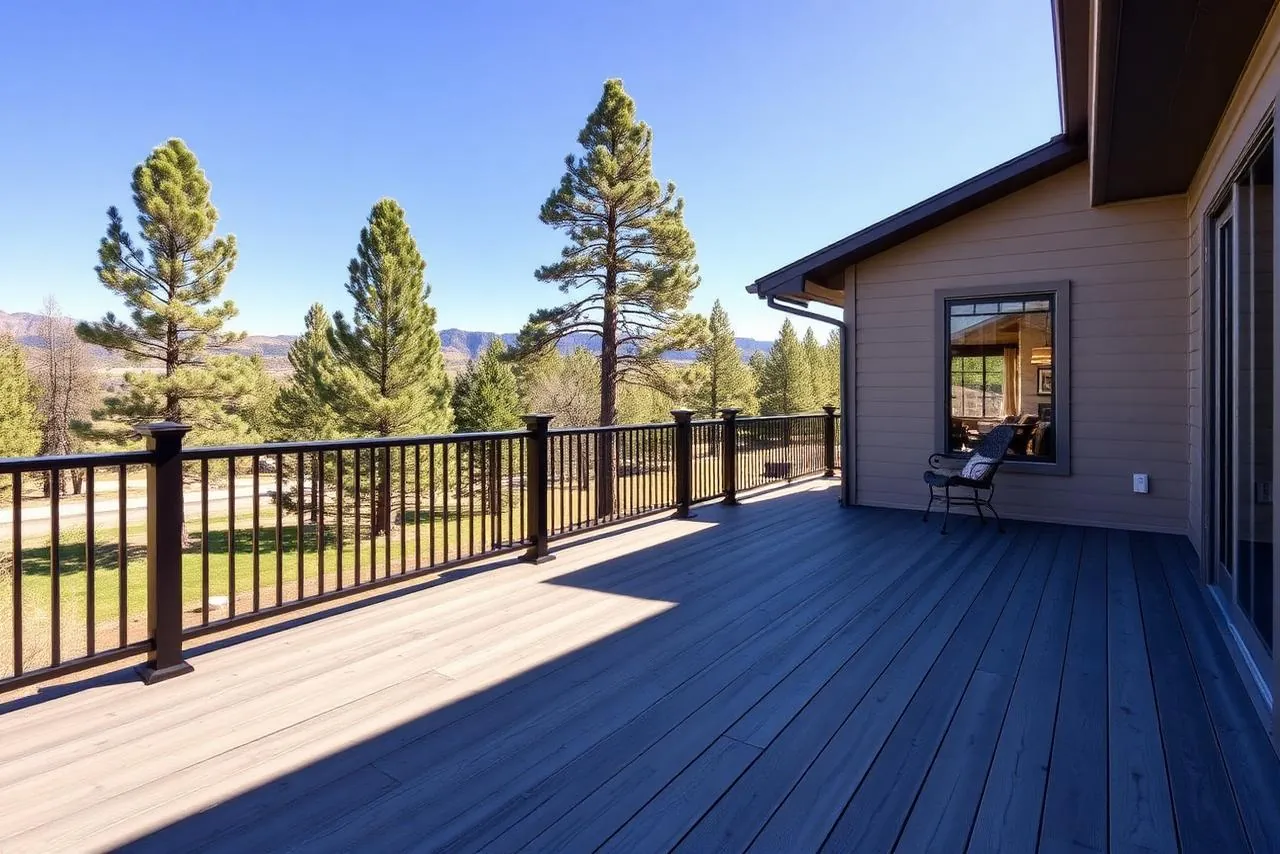
The city’s Appendix K requires decks and other habitable spaces to be of ignition resistant or non-combustible decking materials, such as composite or metal decking. The sentence above is the operative part, and in Class II the walking surface cannot be wood.
City of Colorado Springs Fire Code, Appendix K — Colorado Springs Wildfire Resiliency Requirements, §K109.2.7 (adopted by Ordinance 26-18, finally passed 12 May 2026, effective 25 May 2026). Verified 2026-08-19.
What the rule does not cover
This is where the confusion sits, so it is worth being precise about both halves.
| Component | Can it be wood? |
|---|---|
| Decking surface | No |
| Stair treads | No — treads are walking surface |
| Large structural components | Yes |
| Railings | Yes |
| Support posts on a covered deck | Yes |
So the rule is narrower than people assume and wider than they hope. It is not a ban on wood decks. It is a ban on wood underfoot. A cedar post carrying a gabled cover is fine; the treads on the stairs leading up to it are not.
The state requirement underneath it
The statewide code speaks to the same surface, in different language. Under Colorado Wildfire Resiliency Code §404.5, in Moderate and High Fire Intensity areas, unenclosed deck walking surfaces have four compliant routes:
| Noncombustible | Metal or other noncombustible surface |
|---|---|
| Class A rated | Exception: Class B composite is permitted |
| Fire-retardant-treated wood | Treated for exterior use |
| Ignition-resistant | As defined at §402.4 |
Read the two documents together and the city’s position is clear. The state leaves a route open for fire-retardant-treated wood. Appendix K closes it for the decking surface inside the city. When the two disagree, the stricter one is the one you build to.
Colorado Wildfire Resiliency Code §404.5 and §402.4. Verified 4 August 2026.
Mesh at the base of walls and posts
The part nobody expects, because it is not about the deck boards at all. Appendix K also requires the base of exterior walls and posts to be protected — with fire-resistant foam, or with wire mesh whose openings are no larger than one-eighth of an inch.
One-eighth of an inch is the whole point of the specification. Insect screen and standard hardware cloth are not interchangeable here, and the difference is not visible from ten feet away. It is worth confirming the mesh spec on site rather than after the final inspection.
“WUI compliant” is not a rating
The distinction that catches people out, including people who did their homework.
A decking product can be marketed as “WUI compliant” without carrying a flame-spread class. The class is what the code asks for. “WUI compliant” is a marketing phrase; Class A and Class B are test results.
Colorado tests to ASTM E84, UL 723 and ASTM E2768. Those are the standards a rating comes from. If a product line is going into an overlay address, the specific line and color need checking against the published rating before the order goes in, not after the boards arrive on a pallet. Manufacturers rate by product line, and a line can change.
Zones 1, 2 and 3
Defensible space in Colorado is described in three zones, measured out from the structure:
Zone 1
0–5 ft from the structure. Noncombustible hard surface.
Zone 2
5–30 ft.
Zone 3
30–100 ft.
There is no “Zone 0” in Colorado. The five-foot noncombustible concept exists here — it is simply the first five feet of Zone 1. The label does not, and using it in a conversation with the city produces a pause rather than an answer.
For a deck this matters because an attached deck sits inside Zone 1 by definition. The first five feet out from the house is the deck.
What it changes about the build
Practically, the overlay moves three decisions.
- The material budget. Wood is out underfoot, so the planning range starts at composite rather than at pressure-treated pine. Composite and PVC run $45–95 per square foot installed against $35–60 for pressure-treated pine and $50–75 for cedar, as of August 2026. Those are estimates, not quotes — the cost page shows the arithmetic and the sourcing behind them.
- The framing conversation. Steel deck framing is sold on the Front Range on Class A fire rating — Fortress Evolution, Trex Elevations, Cemco and Forever Frame are all marketed on it. Appendix K does not require it; wood is still permitted for large structural components. It comes up because people in the overlay ask about it.
- The sequence. The overlay question belongs before the drawings, not after. Material substitutions made at plan review cost time; material substitutions made after delivery cost money.
If you are replacing the surface on an existing deck, the same rules attach the moment the boards come off — see deck repair and replacement. And the overlay does not remove the permit question; it sits alongside it. Permits and PPRBD fees covers that side.
Common questions
How do I find out if I am in the overlay?
The city maps it parcel by parcel. Send the address through the wildfire zone tool and you get a written answer back within 1–2 business days. If the parcel sits on a boundary we say so rather than guess, and point you at the city for the determination.
Do I have to replace my existing wood deck?
Whether an existing structure has to change is a determination the city makes, and it is not something to take from a website. What is clear is the rule for what gets built: inside the overlay in Class II, a new or replacement decking surface cannot be wood. If you are already planning a resurface, that is the point the rule attaches.
Can I keep wood railings?
Yes. Appendix K permits wood for railings and for large structural components — the restriction is on the walking surface. Whether you want a wood railing on a deck you cannot surface in wood is a separate question, and the railing section sets out what each system actually asks of the frame.
Is composite automatically allowed?
Composite is the material the city names as an example of an acceptable one, alongside metal decking. But the state code sets the rating expectation, and its exception is specifically for Class B composite. So the answer is the product line, not the category. Check the published rating for the exact line before ordering.
Do the stairs count?
Treads are walking surface, so yes. Stringers are structure. This is the single most common thing missed on an overlay project, because the stairs are drawn last and specified in a hurry.
Does the overlay change my permit?
It does not change whether you need one — that test is separate, and it lives on the permits page. It changes what the plan set has to specify, because the decking material and the stair treads have to be named on the drawings as compliant products.